PUZZLE GAME
A drawn line that becomes the arm's route
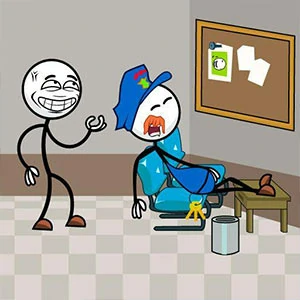
Thief Puzzle Online gives you a room full of physics objects, ropes, a character made of separate body parts, and police who patrol the floor. The core action is drawing: you trace a line across the scene and the thief's extending arm follows it, reaching whatever the stroke passes over.
That line is the whole plan. You can also drag and rotate the props already in the room, but the route itself is drawn, and it is the part that decides whether the arm arrives cleanly or clips a guard on the way. Everything else in the level exists to make that single stroke harder to place.
REACH THE OBJECT
Get the extending arm to its target untouched
A room is cleared when the arm reaches its object without touching a guard or a hazard along the way. The arm is thicker than the line you draw, so a route that looks clear on the stroke can still fail once the full width of the reach is counted.
That gap between the line and the reach is what makes the levels worth reading twice. Clearance has to exist on both sides of the stroke, not just under it, and the safest route is usually the one that runs down the middle of an open lane rather than along the edge of one.
DRAW, THEN RELEASE
Trace the route and let go to send the arm
Control starts with a drag: press, trace the path you want the arm to take, and release. The route is locked the moment you let go, so there is no steering it afterwards. The props in the room can be dragged and rotated before that, which is how you open a lane that was not there to begin with.
Because the stroke is committed at release, one unbroken motion beats a route assembled in pieces. Settle the room first, decide the lane, then draw it in a single pass. A half-drawn route is the most common reason an attempt has to be restarted.
WATCH A PATROL LAP
Spend the opening run reading the room
The first attempt on a new room is best spent watching rather than drawing. Follow the guards through one full lap, note where they turn and where they linger, and find the stretch of floor they leave open the longest.
Once you know the patrol rhythm, the props make more sense: a rope or a limb you can rotate is usually there to widen an existing gap rather than to create one. Read the room in that order and the route tends to suggest itself before you have drawn anything.
LEAVE CLEARANCE
Give the reach room on both sides
A stroke that hugs a guard's shoulder fails on the smallest misjudgement, because the arm needs space on both sides of the line rather than only along it. Trace the middle of a gap instead of its edge, so a slight wobble still clears everything the reach passes.
The same margin matters at the far end. Let the stroke finish past the object rather than stopping exactly on it, since the arm extends along the whole line you drew. A little slack at both ends is what turns a nearly-right route into a clean one.