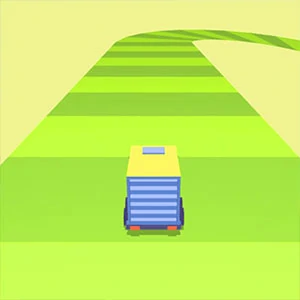
The twisting route
A route that bends without end
Winding Road sends a vehicle along a route that doubles back on itself with little room on either side. The surface ahead keeps changing direction, so the challenge is to steer in small, measured moves instead of throwing the vehicle from edge to edge and hoping it stays on.
The narrower the margin, the more each input counts. A bend you could take lazily at one width becomes a tight negotiation at another, which keeps the driving honest from the first corner to the last, however long the road happens to run.
Far is the score
Measure progress in distance
There is no finish line to chase, because your score is simply how far you travel. The run ends the moment any part of the vehicle slips off the path, so every correction you make is really about buying a little more distance rather than reaching a marked goal.
Because the road is effectively endless, survival is the whole game: the vehicle that stays on longest travels farthest. That framing changes how you judge every move, since a calm correction that earns a little more road is worth more than one that looks flashy but ends the run.
Small corrections
Turn with light inputs
Use the left and right arrow keys, the mouse, or the touch controls the game shows. Your input turns the vehicle's direction rather than snapping it to a spot, so you have to lead each bend a little and let the vehicle arc through the corner.
Treat the steering as a flow rather than a sequence of clicks: gently feed in the turn, hold it through the apex, then release as the road straightens. Heavy or jerky input is what usually slides a wheel over the edge before the bend even ends.
Read the road ahead
Set up before the bend
As you start rolling, read the next couple of bends instead of reacting only to the edge in front of you. Begin each correction early and drift back toward the middle as soon as you clear a turn, so the road never catches you mid-swing.
The title screen hands you a PLAY button and a settings entry before each session, so take a moment to check them first, then run a short test lap to feel how far the vehicle turns with each input. A couple of quiet minutes of feel beats hours of guessing on the live road.
Come back to middle
Settle back to the center
The middle of the road gives you the most room to recover from a mistake. After each bend, settle the vehicle back to center before setting up for the next turn, and you turn every corner from the strongest possible starting position.
Racing back to the middle after every corner also keeps your responses predictable: when a sudden kink appears, you have slack on both sides instead of a wheel already hanging near the lip. Distance runs reward that quiet consistency more than any single flashy recovery.